
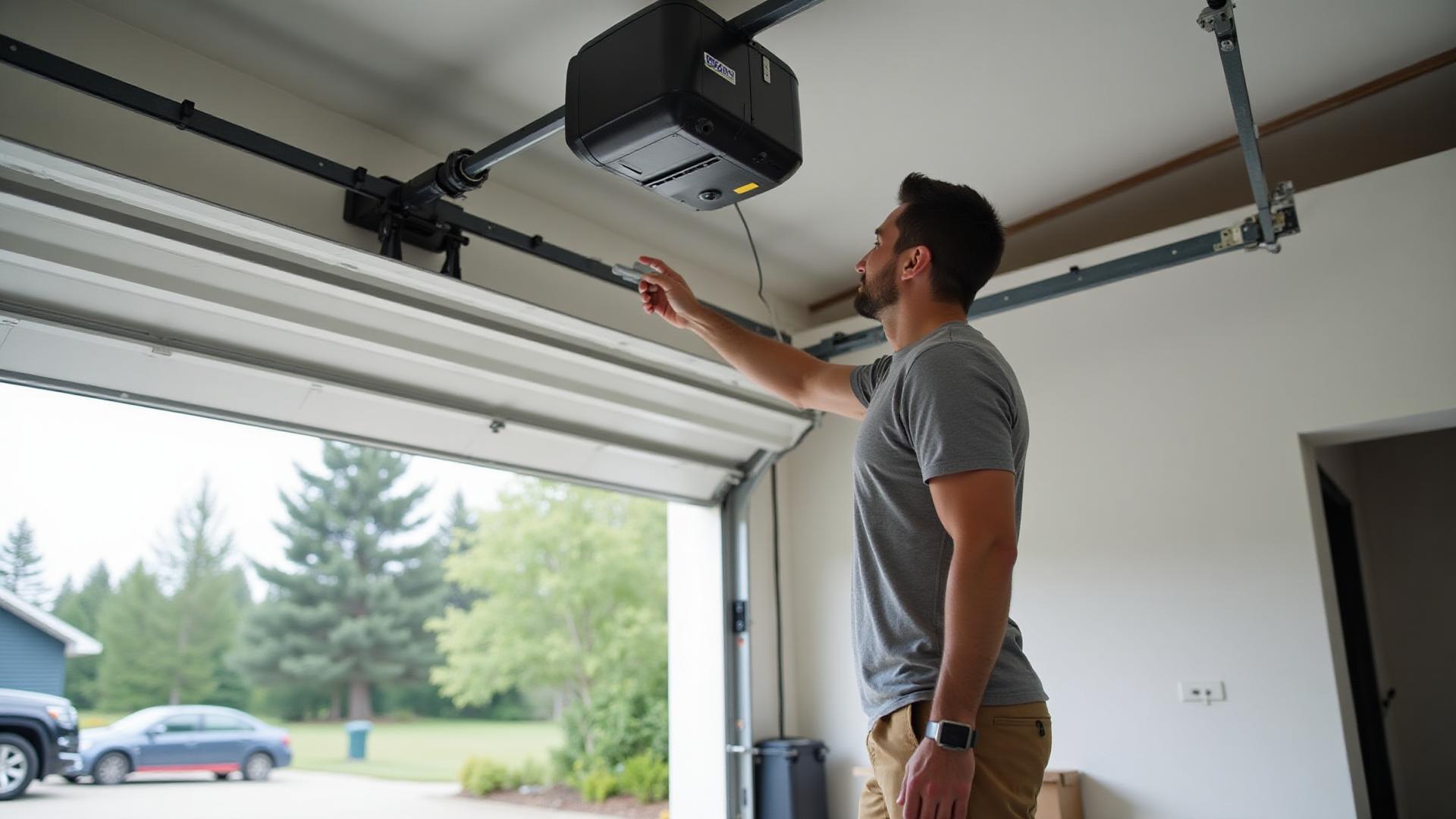
Part of our Garage Door Opener Repair services.
Plan the opener around the door and the garage
A new opener installation starts with the garage and door rather than an old unit. We plan the rail or wall-mount position, structural support, power and controls, safety-sensor path, lifting capacity, and desired features as one coordinated system. This service suits new doors, first-time openers, garage conversions, and layouts being upgraded for new uses.
- A new door has no operator yet
- A manual door is being automated
- The garage layout or use has changed
- Ceiling height limits a standard rail
- Wi-Fi control or battery backup is desired
- New mounting, wiring, or controls are required
New installation is more than replacing a motor
A replacement begins with an established opener location and usually an existing outlet, control wires, sensor path, and mounting framework. A new installation may have none of those. We determine where the operator can work without interfering with lighting, storage, beams, attic access, vehicle clearance, or door travel. The objective is not merely to suspend a motor; it is to create a stable operating system whose rail, arm, sensors, controls, and power all fit the space. It complements our opener repair and replacement services.
This distinction is important for a newly installed garage door, a door that has always been opened by hand, or a converted garage where ceilings and walls have changed. It also matters when an owner wants to move from a conventional overhead layout to a wall-mount design. We review how the garage is used, where people enter, where a keypad would be useful, what connected features are wanted, and whether the door itself is balanced and ready for powered operation.
Door balance and opener capacity come first
An opener should guide a balanced door rather than lift its full weight. Before selecting equipment, we disconnect or manually test the door, check whether it remains controllable through travel, and inspect springs, cables, rollers, hinges, tracks, panels, and top-section reinforcement. A new motor cannot safely correct a broken spring or binding track. Mechanical issues are identified before installation so the operator is not asked to overcome resistance with excessive force. If an older unit is already mounted, garage door opener replacement covers swapping it out.
Capacity is selected from door size, height, construction, insulation, weight, expected use, track arrangement, and manufacturer guidance. Horsepower or equivalent ratings are part of the decision, but not the entire decision. A wide insulated door and a lightweight single door place different demands on the rail and attachment points. Tall doors need compatible rail length. The top section must support the opener arm without flexing, and travel geometry must allow full opening without pulling the door beyond its intended position.
- Verify spring balance and smooth manual travel
- Match capacity to the actual door
- Select a rail for the correct door height
- Confirm top-section reinforcement
- Keep the opener clear of storage and lighting
Need help with your garage door?
Call (619) 768-0325Ceiling height, clearance, and rail layout
Standard trolley openers run on a rail centered above the door. The rail needs clear space between the header and motor location, and the motor needs secure support from structural framing. Ceiling height, slope, beams, ductwork, lights, storage racks, and door track all influence placement. On finished ceilings we identify sound mounting locations rather than fastening only to surface material. On open framing, angle supports must hold the unit stable and level without obstructing the door. Many homeowners pair a new unit with a smart Wi-Fi opener upgrade.
The rail length must suit the door height and opener model. A rail that is too short may not open the door fully; improvised extensions can create poor movement or unsupported joints. Door-arm geometry also matters because an incorrect angle can place unnecessary force on the top section. We measure the opening, high point of travel, ceiling distance, and proposed motor position. Those measurements determine whether a standard overhead unit, compatible extended rail, or another arrangement is appropriate.
Wall-mount openers for high or open ceilings
A wall-mount or jackshaft opener attaches beside the door and turns the torsion shaft directly. Removing the center rail can preserve overhead space for high ceilings, car lifts, storage, lighting, or architectural features. It can also reduce equipment above a tall vehicle. That makes wall-mount systems attractive for some garage conversions and high-lift doors, but the layout has specific requirements that must be checked before a model is chosen.
The door generally needs compatible torsion hardware and sufficient side room at the shaft. Outlet position, cable tension monitoring, shaft condition, drum setup, door balance, and track configuration matter. Some doors need additional equipment to maintain cable tension or secure the closed door. We evaluate those factors and compare wall-mount and overhead choices honestly. A high ceiling alone does not guarantee compatibility, and a standard opener may still be the simpler solution when the rail can be mounted correctly.
Power, controls, sensors, and wiring
Most ceiling-mounted units need an electrical outlet near the motor location rather than a permanent extension cord. Wall-mount units need suitable power near the side of the opening. We identify the manufacturer's placement requirements and coordinate the opener around available power. If a new permanent outlet or circuit work is needed, that work should be handled by an appropriately qualified electrical professional before or as part of the broader project.
Low-voltage wiring connects the wall control and photo-eye safety sensors. We plan routes that avoid hinges, tracks, sharp edges, stored items, and places where wire can be snagged. Sensors are mounted near the floor, aimed precisely across the opening, and checked for steady indicators. Wall controls go where the operator can see the door and keep the control away from small children. Wireless keypads are placed for practical exterior access while following the selected manufacturer's installation guidance.
Smart control, battery backup, and useful options
Wi-Fi enabled openers can provide app control, status alerts, activity history, and shared access depending on the model and manufacturer service. Setup requires a compatible phone, account, and adequate wireless signal in the garage. We program available connected functions and explain what relies on internet service. Smart control is convenient, but physical safety sensors, secure remotes, and correct door operation remain fundamental whether or not an app is connected.
Battery backup can preserve supported opener operation during a power outage and may be valuable when the garage is a primary entrance. Lighting, camera features, motion detection, keypad compatibility, and vehicle controls are other options. We help narrow choices based on how the household uses the opening rather than treating every add-on as necessary. Feature availability differs among LiftMaster, Chamberlain, Genie, and other manufacturers, and brand discussion does not imply authorized-dealer status.
Installation, programming, and safety testing
After the plan is confirmed, we assemble the specified rail and carriage or prepare the compatible wall-mount location. Supports are attached to suitable structure, the operator is aligned with the door, and the connection arm is positioned for controlled travel. We mount the wall control and photo eyes, route wiring, connect approved power, and set open and closed limits. Force or automatic calibration is completed according to the selected system rather than used to overpower resistance.
Commissioning includes full-cycle observation, manual release operation, photo-eye interruption, and the prescribed contact-reversal test. We listen for rubbing, vibration, loose support, and changes in track movement. Compatible remotes, keypads, vehicle controls, and smart features are programmed after mechanical and safety testing. We then explain controls, emergency release, routine visual checks, and how to repeat the manufacturer's reversal test. A new setup is complete only when the door and operator function together safely.
- Secure and align the selected operator
- Set travel without excessive force
- Align and test both photo eyes
- Verify contact reversal and manual release
- Program access devices and explain operation
Cost factors and opener installation across East County
Installation cost depends on opener type and capacity, rail length, wall-mount compatibility, battery and connected features, mounting complexity, ceiling construction, outlet readiness, control and sensor wiring, accessories, and any door work needed before automation. A straightforward new-door setup is different from adapting a converted garage with a tall ceiling and no suitable power. We inspect the actual conditions and offer a free quote without presenting a generic amount that ignores the space.
KC Garage Doors is locally owned and fully insured, based in Santee and serving Lakeside, El Cajon, Alpine, La Mesa, East County, and San Diego County. Our role is to help you choose a layout and feature set that fits the door and daily routine, install it carefully, and complete the safety checks. For a failed unit already in place, our opener replacement page explains the swap process; this installation service focuses on building a new or upgraded setup from the garage outward.
What local customers say
“Kameron was fantastic. Showed up on time, diagnosed the broken spring quickly, and had us back up and running the same afternoon. Honest pricing and great communication.”
“KC Garage Doors did an excellent job replacing our opener. Professional, clean install, and walked me through the new smart features. Highly recommend.”
“Called in the morning with a broken cable and they were out by early afternoon. Fair price, no upsell, great work.”
Related garage door services
Replace an existing failed, noisy, or outdated opener with a compatible modern unit.
View service detailsCorrect sensor alignment, wiring, lens, and closing problems on an installed opener.
View service detailsExplore opener troubleshooting, controls, and repair from the main service hub.
View service detailsGarage Door Opener Installation FAQs
Get a careful diagnosis and a free quote
Tell us what the door is doing, and we will help you plan the safest next step.
Cities we cover for Garage Door Opener Installation
Same-day garage door opener installation across San Diego County — click any city for local pricing, neighborhood coverage, and specifics on the door types we see there.
- Garage Door Opener Installation in La Jolla
- Garage Door Opener Installation in Del Mar
- Garage Door Opener Installation in Hillcrest
- Garage Door Opener Installation in Kearny Mesa
- Garage Door Opener Installation in Rancho Bernardo
- Garage Door Opener Installation in San Marcos
- Garage Door Opener Installation in Vista
- Garage Door Opener Installation in Alpine
- Garage Door Opener Installation in Ramona
- Garage Door Opener Installation in Lemon Grove
- Garage Door Opener Installation in El Cajon
- Garage Door Opener Installation in Chula Vista
- Garage Door Opener Installation in Poway
- Garage Door Opener Installation in Santee
- Garage Door Opener Installation in La Mesa
- Garage Door Opener Installation in Escondido
- Garage Door Opener Installation in Coronado
- See all service areas →