
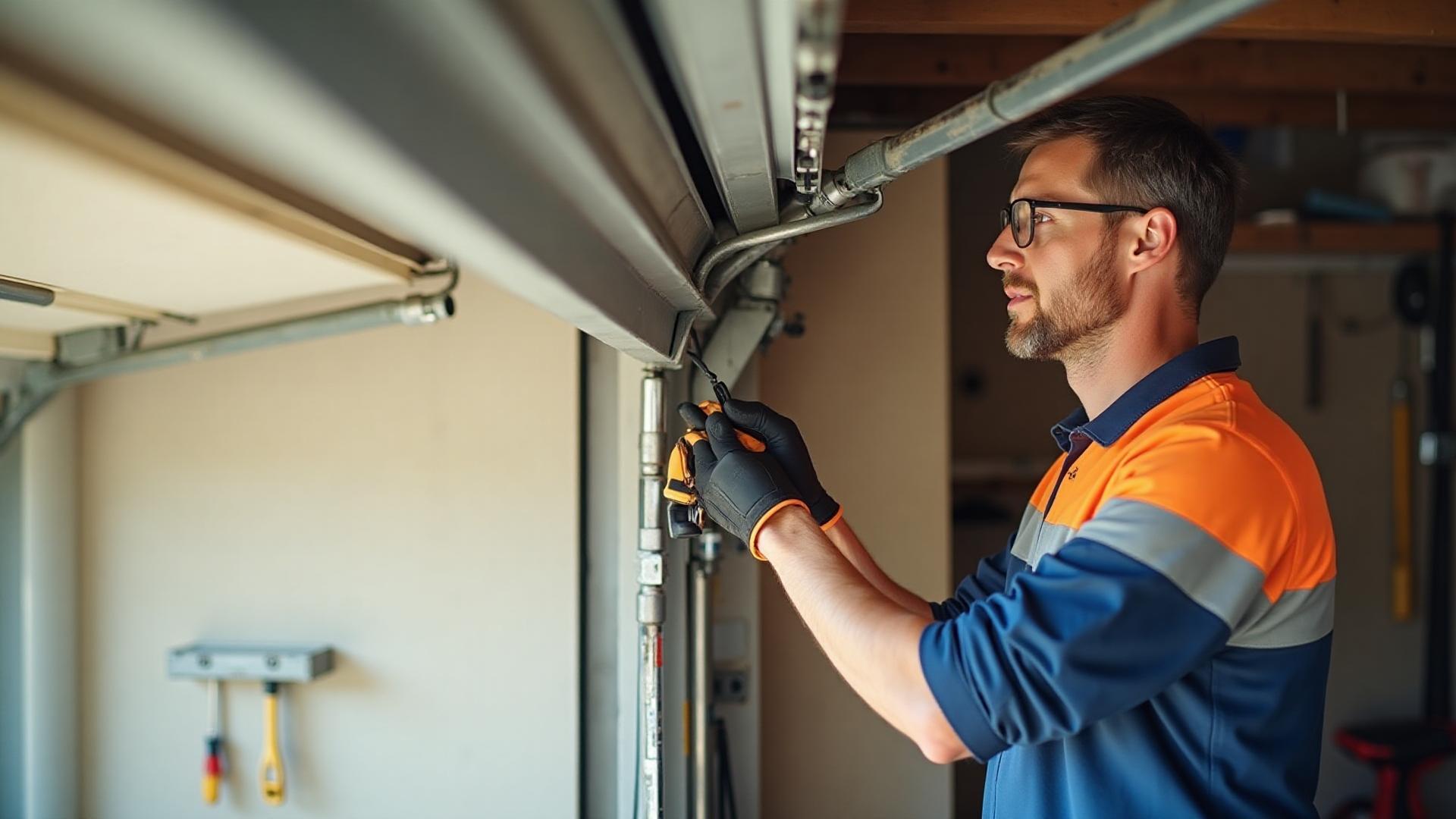
Part of our Spring Repair & Replacement services.
Professional help when your door cannot operate safely
Extension springs are long, exposed coils that run beside the upper tracks rather than on a shaft over the opening. Each spring stretches as the door closes and contracts as it rises, working through pulleys and lift cables on its own side. Our extension spring service in Santee focuses on that complete arrangement: matching both springs to the door, containing them with safety cables, correcting worn pulley hardware, and restoring even movement.
- A visible gap or stretched coil in one side spring
- The door feels heavy or will not stay halfway open
- The door lifts unevenly or looks crooked while moving
- A loud bang from the garage followed by a slack spring
- A cable hanging loose or a pulley that wobbles or squeals
- Springs with no safety cable running through the center
Extension vs. torsion springs: how to tell which you have
Stand inside the garage with the door closed and look above the opening without touching any hardware. A torsion setup has one or more compact coils wrapped around a metal shaft directly over the top section. An extension setup has a long spring near each side wall, usually positioned above and parallel to the horizontal tracks. These side springs may be partly hidden by storage or low ceilings, but there is no spring-bearing shaft spanning the doorway. Both designs fall within garage door spring repair, yet their parts and service procedures are different.
Extension springs change length visibly. They stretch toward the rear of the garage when the door closes and shorten as the door opens. Their lifting force travels through pulleys and cables instead of cable drums on an overhead shaft. This design appears on many older installations and single-car doors, although door age or width alone cannot identify it. If you see a spring beside each horizontal track, do not assume a replacement based only on length or paint color; the door and the complete pulley layout still need to be measured.
Signs an extension spring is failing
An extension spring can lose useful pull before it separates. The first clue may be a door that hangs lower on one side, rises diagonally, or requires more effort near the floor. You may see irregular spacing between coils, a stretched section that does not recover, rust around an end loop, or one spring hanging differently from its partner. A pulley may tilt as the weak side struggles to keep pace. These are specific two-sided balance symptoms, not simply signs that the opener needs more force.
When an extension spring snaps, homeowners often hear a sharp bang from beside or behind the tracks. The broken coil may hang in two pieces, the cable can go slack, and the affected side of the door may sag. Stop operating the door. Running the opener can pull the unsupported side upward unevenly, push rollers against the track edge, or allow a loose cable to catch on nearby hardware. Keep clear of the springs and do not try to reconnect an end loop under tension.
- Door heavier to lift by hand than before
- Opener strains, slows, or reverses near the top
- One side of the door lower than the other
- Stretched, rusted, or separated spring coils
Need help with your garage door?
Call (619) 768-0325Safety cables: why every extension spring needs one
A containment cable passes through the hollow center of an extension spring and anchors independently at the front and rear of the track assembly. It does not carry the door or adjust spring strength. If a coil, hook, eye bolt, or spring end breaks, the cable limits how far the released spring can travel. Without that restraint, a stretched spring can whip across the garage or strike a vehicle, wall, stored item, or nearby person.
Because extension springs sit along open ceiling space, the containment path needs to remain straight, secure, and clear of the moving pulley system. We check both anchors, cable condition, and routing during replacement. Older East County garages and previously altered single-car setups sometimes have no containment cables at all. When they are missing, we install them with the new springs rather than putting the side-mounted system back into operation without this important safeguard.
Pulleys, sheaves and lift cables
An extension system changes the direction of spring force through pulleys, sometimes called sheaves. One pulley is commonly attached to the moving end of each spring, while another guides the cable near the track. Their grooves must suit the cable, their bearings must turn freely, and their attachment points must remain aligned. A pulley that wobbles, squeals, binds, or has a worn groove can abrade the cable and make one spring appear weaker than the other.
We inspect every cable path before fitting springs. Frayed strands, flattened cable, rust near the bottom bracket, a damaged pulley groove, or a loose fork and clevis can undermine a new pair. When those parts are worn, we explain the needed garage door cable repair and replace affected hardware alongside the springs. We also watch the rollers while the door moves because a binding wheel can add uneven resistance; a separate garage door roller replacement may be appropriate when wheels are damaged rather than merely dry.
- Fixed and moving pulleys that turn without wobble
- Grooves free of sharp edges that can cut cable strands
- Lift cables routed correctly through the pulley system
- Forks, clevis pins, eye bolts, and rear hangers secured
Why we replace them in pairs
The left and right extension springs act separately, but the door depends on them producing closely matched pull. They are generally installed together and experience the same number of openings, hot afternoons, dusty conditions, and periods of full stretch. If one breaks, the remaining spring has usually accumulated the same service history. Its coils may still look intact while its length and tension no longer match a new spring.
Installing one fresh spring beside one fatigued spring can cause the door to rise faster on one side. That uneven lift changes cable tension, tips the moving pulleys, and presses rollers against the tracks. We therefore generally replace extension springs as a matched pair selected for the actual door. After installation, we compare cable routing and spring stretch on both sides, then guide the door by hand to confirm that the bottom edge remains level through its travel.
Converting from extension to torsion springs
Conversion can make sense when a homeowner wants to replace the separate side pulley arrangement with a shaft, drums, and a spring assembly above the opening. It may also be considered when repeated pulley trouble accompanies an aging extension setup or when the door configuration is changing. This is more than exchanging one type of coil for another: the new counterbalance layout needs suitable headroom, sound mounting support, compatible tracks, correctly placed bearing plates, drums, and new lift-cable routing.
Not every extension-spring door needs conversion. A properly matched pair with sound pulleys, lift cables, hangers, and containment cables can remain a practical system. We inspect the opening and discuss the difference without steering every homeowner toward the larger scope. When a shaft-based arrangement suits the door and available space, our torsion spring replacement service explains how that system is measured, installed, and balanced.
How we replace an extension-spring system
We identify both spring paths, secure the door in a controlled position, and compare the left and right hardware before removing parts. Measurements cover the door, spring body and end style, available stretch, attachment points, pulley arrangement, and cable route. We inspect rear track hangers and eye bolts because extension springs pull against those supports whenever the door is closed. The replacement pair must fit the door and the existing geometry rather than merely resemble the old coils.
After releasing the extension load in a controlled sequence, we replace the matched springs and any approved worn pulley or cable parts. Safety cables are routed through both coils and anchored independently. We set the side connections so the springs begin and end their travel together, move the door slowly by hand, and compare the bottom edge throughout the opening. Only after the two sides lift evenly do we reconnect the opener and check normal travel and safety functions.
Local service for Santee and East County
KC Garage Doors is based in Santee and serves extension-spring doors across East County and San Diego County. Inland heat, dust, and daily temperature changes can dry pulley bearings, expose corrosion around cable ends, and make existing side-to-side differences easier to notice. Detached garages and older single-car openings also deserve a careful look at rear hangers and containment-cable anchors before new springs are put under stretch.
The scope depends on the door's weight and geometry, spring dimensions, end connections, safety-cable status, pulley and lift-cable condition, and whether earlier alterations left the two sides mismatched. We inspect those extension-specific details and provide a free quote before proceeding. The objective is a contained, even-running side-spring system with sound supporting hardware—not a generic spring swap.
What local customers say
“Kameron was fantastic. Showed up on time, diagnosed the broken spring quickly, and had us back up and running the same afternoon. Honest pricing and great communication.”
“KC Garage Doors did an excellent job replacing our opener. Professional, clean install, and walked me through the new smart features. Highly recommend.”
“Called in the morning with a broken cable and they were out by early afternoon. Fair price, no upsell, great work.”
Related garage door services
Correctly sized torsion springs with controlled winding and balance testing.
View service detailsRepair frayed, snapped, or off-pulley lift cables that work with your springs.
View service detailsOur full spring service hub for torsion and extension systems.
View service detailsExtension Spring Replacement FAQs
Get a careful diagnosis and a free quote
Tell us what the door is doing, and we will help you plan the safest next step.
Cities we cover for Extension Spring Replacement
Same-day extension spring replacement across San Diego County — click any city for local pricing, neighborhood coverage, and specifics on the door types we see there.
- Extension Spring Replacement in La Jolla
- Extension Spring Replacement in Del Mar
- Extension Spring Replacement in Hillcrest
- Extension Spring Replacement in Kearny Mesa
- Extension Spring Replacement in Rancho Bernardo
- Extension Spring Replacement in San Marcos
- Extension Spring Replacement in Vista
- Extension Spring Replacement in Alpine
- Extension Spring Replacement in Ramona
- Extension Spring Replacement in Lemon Grove
- Extension Spring Replacement in El Cajon
- Extension Spring Replacement in Chula Vista
- Extension Spring Replacement in Poway
- Extension Spring Replacement in Santee
- Extension Spring Replacement in La Mesa
- Extension Spring Replacement in Escondido
- Extension Spring Replacement in Coronado
- See all service areas →